What Does Winning Look Like for Grocery Retailers?
Four Strategies WD Partners Experts Say Will Define the In-Store Experience
Estimated Read Time: 8 Minutes
Grocery retailers are an unsung hero in our lives, a service that keeps us all moving forward daily. But has its functional, everyday nature resulted in a higher threshold for experiences that are basic and underwhelming?
At WD, we believe in the potential for grocery experiences to be remarkable and engaging while staying accessible and serving their purpose in the community. Our experts break down the four forces that matter most and what retailers and brands should do about them.
About WD Partners: WD Partners is a retail strategy and design firm that has worked with leading grocery retailers and CPG brands across North America to improve in-store experience, store design, shopper engagement, and brand performance. The insights in this series draw directly from that work.
The U.S. grocery industry is worth $1.5 trillion—and every inch of the store is being contested. Quick-service restaurants are competing for lunch occasions. Discount grocers are stealing traffic. AI is beginning to rewire how shoppers discover, decide, and buy. And in the middle of all of it, the in-store experience remains the single highest-leverage asset most retailers are underusing.
We asked four of our experts to share what they’re seeing on the ground with retailers and brands right now. Their perspectives form a new video series on the forces shaping grocery.
1. How Can Grocery Retailers Compete for Meal Occasions Against QSR?

Consumers are rethinking where they eat lunch. Rising restaurant prices and a growing appetite for healthier, fresher food have made the grocery store perimeter a serious alternative to the drive-through. The question for retailers isn’t whether this shift is happening—it’s whether their prepared food offer is positioned to capture it.
The opportunity spans every daypart and every format: fresh-prepared, grab-and-go, made-to-order, meal kits, ready-to-eat, and ready-to-heat. Each is driven by the same underlying consumer need—convenience without compromise on quality or health or value/price. But building a compelling offer is only half the equation. Retailers that are winning are also activating it through loyalty programs, turning a single meal purchase into a frequency driver that builds the basket over time.
$1.5T The U.S. grocery industry’s total value — with fresh-prepared meals among the fastest-growing segments, driven by consumers seeking healthier, more affordable alternatives to dining out.
Two retailers illustrate what leadership looks like here. H-E-B has built one of the most celebrated prepared foods programs in U.S. grocery with a perimeter offer—from its Meal Simple line to in-store cooking demonstrations and freshly made tortillas—that drives genuine destination traffic and reinforces the brand’s deep community roots. It’s a masterclass in turning the store perimeter into a reason to choose one retailer over another. H-Mart takes a different but equally instructive approach: by centering fresh and prepared foods around cultural meal occasions, it has built fierce loyalty among shoppers who see the store as the only place that truly understands how they cook and eat. Both models point to the same truth—the perimeter wins when it reflects the actual lives and meal occasions of the people shopping it.
For CPG brands, the perimeter increasingly represents a partnership opportunity: co-creating meal solutions, contributing to store-branded prepared offerings, and showing up in the moments when shoppers are making the highest-value decisions of their trip.
2. How Can Grocery Retailers Drive Traffic Back to Center Store?

Center store has a traffic problem. As more routine pantry replenishment moves online, the middle aisles face an existential question: what is their role in a world where shoppers can reorder staples with a tap?
The competitive threat makes the urgency clear. Focused formats—Aldi, Trader Joe’s, Lidl—are outpacing traditional full-service grocery on traffic growth by leaning into curation and value. Even Target has stepped back from trying to carry everything, building a tighter, more intentional assortment instead. Traditional grocers that compete on breadth alone are losing.
Focused grocers like Aldi, Trader Joe’s, and Lidl are consistently over-indexing on traffic growth versus traditional full-service grocery—driven by curation over selection. Private label penetration in these formats regularly exceeds 70–90% of SKUs.
The path forward isn’t shrinking center store for the sake of it—it’s making every foot of it earn its place. That means rethinking the role of private label, which can serve shoppers across the entire value spectrum while giving the retailer margin advantage and differentiation that national brands alone can’t provide. It also means using endcaps, cross-merchandising, and discovery moments to break shoppers out of their rote missions and introduce them to something new.
For category managers and CPG partners, this is both a challenge and a moment of leverage. Brands that help retailers solve the center store traffic problem—through innovative display, exclusive or retailer-specific formats, or genuine category leadership—will earn more than shelf space. They’ll earn preference.
3. What Role Does AI Play in the Grocery Customer Experience?

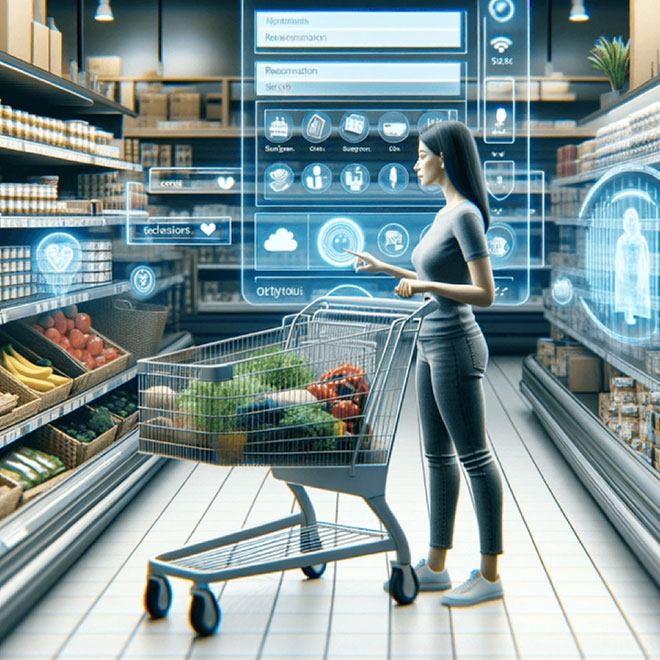
The most enduring question in grocery is also the simplest: “What’s for dinner?” For decades, answering it was the shopper’s problem. Now, AI is making it the retailer’s opportunity.
Leading grocers are already integrating AI throughout the shopper journey. Kroger’s partnership with Google Cloud takes a shopper’s dinner idea all the way through to a guided recipe with a shoppable ingredient list. Wegmans supports mission-based trips through AI-enabled in-store tools via Instacart and smart shopping cart technology. Amazon’s Rufus and Walmart’s Sparky are embedding conversational AI directly into retail apps—turning search into dialogue and dialogue into purchase.
53% of grocers are actively investing in AI-powered personalization tools and strengthening data and fulfillment systems to support smoother omnichannel experiences. (Grocery Doppio, 2025)
This is more than a technology story, it’s a loyalty story. When a retailer helps a shopper solve their mealtime problem by surfacing the right recipe, populating the cart, and making the decision easy, that shopper has a reason to come back. The retailers building the deepest AI integration aren’t just improving convenience; they’re building behavioral stickiness that competitors can’t easily replicate.
For brands, the implications are significant. As AI increasingly mediates discovery and selection, appearing in a shoppable recipe recommendation or a personalized suggestion becomes as important as prime shelf placement. The question worth asking now: how does your brand show up in an AI-assisted shopping journey?
4. How Do Grocery Retailers Build Brand Love In-Store?

Food is a deeply personal experience that’s woven into everything we do. It’s a reflection of our culture and values, it’s central to special occasions, and the preparation and sharing of food is one big way that we show our love for friends and family.
Great grocery brands design their digital and physical experiences around the idea of connection through food, nurturing loyalty that starts with the heart. It’s built in the small moments—when a shopper finds exactly what need, when the store feels like it understands them, and when the brand shows up with the right help at the right time.
Three principles of brand love:
Take care of your customer. Wayfinding is the most underrated tool in the store. Clear, intuitive wayfinding signals hospitality and respect for their shopper’s time. It reduces stress, increases efficiency, and makes the entire experience feel considered.
Tell your shoppers how you feel. Shoppers are increasingly choosing where to spend their grocery dollars based on values alignment, and they’re making that judgment while walking the aisles. If the brand isn’t communicating its values clearly and consistently in-store, it’s leaving one of the most powerful touchpoints in retail completely silent.
~70% of purchase decisions are made in-store, not before shoppers arrive — making every shelf, sign, and store experience a live brand moment. (POPAI/Path to Purchase Institute)
Show up in the moments that matter. Shoppers don’t just need products—they need reassurance, inspiration, and empowerment. Retailers and brands that meet shoppers there—with contextual information, smart merchandising, helpful prompts—build value that goes beyond price.
For CPG brands, this is an invitation to think beyond placement. Your packaging, your shelf communication, your in-store presence—all of it is either contributing to a shopper’s sense of ease and connection, or adding to the noise. The brands building the deepest loyalty are the ones treating every in-store touchpoint as a chance to start a conversation.
The Common Thread
Across all four areas, a single insight connects the dots: the retailers winning in grocery right now are the ones treating the in-store experience as a competitive advantage, not a cost center. Whether it’s a lunch occasion captured at the deli counter, a center store aisle that surprises and delights, an AI recommendation that solves dinner before the shopper even asks, or wayfinding that makes a shopper feel genuinely taken care of—the common denominator is intentionality.
Grocery is a category where the margin for indifference is shrinking fast. The brands and retailers pulling ahead aren’t doing it on price or assortment alone. They’re doing it by designing every touchpoint to earn trust, build loyalty, and create the kind of experience that brings people back—not because they have to, but because they want to.
Frequently Asked Questions
How can grocery retailers compete with QSR for meal occasions?
How can grocery retailers drive traffic back to center store?
What role does AI play in the grocery customer experience?
Why does in-store wayfinding matter for grocery brand loyalty?
How do grocery retailers build brand love in-store?
What is WD Partners’ expertise in grocery retail?
We’ve helped retailers and brands work through these exact challenges—from store perimeter strategy and center store reinvention to AI integration and building genuine brand love in-store. If any of these topics are on your radar, we’d love to talk.
-
![Solution Story - Meijer]() Solution Story
Solution StoryMeijer
Reinvigorating a Midwest Icon Through a Connected Shopper Journey
-
![Wayfind - Becoming the Builders of Digital Infrastructure]() Wayfind
WayfindBecoming the Builders of Digital Infrastructure
Creating Strong Data from Design Through Construction
-
![Solution Story - Fred Meyer]() Solution Story
Solution StoryFred Meyer
Optimizing Labor for the Modern Superstore
-
![Wayfind - The Grocery Revolution Part 3 of 3]() Wayfind
WayfindThe Grocery Revolution Part 3 of 3
Understanding the 2040 Consumer Across Generations