What’s Behind Construction Delays in Retail, Restaurant & Convenience Store Development—And How to Get Ahead of Them
Estimated Read Time: 4 Minutes

Construction timelines across retail, restaurant, and convenience store development are stretching 100–200 days beyond projections due to four compounding factors: labor shortages, rising material costs, permitting delays, and technology gaps. For operators with aggressive growth plans, these aren’t just inconveniences—they’re direct threats to opening dates and capital budgets. Here’s what WD Partners is seeing on the ground, and how leading brands are building programs that stay ahead of it.
Why Is Skilled Labor So Hard to Find in Retail, Restaurant & C-Store Construction?
The skilled labor shortage is the most persistent cost driver in multi-unit construction today. Wages are rising 5–8% annually, qualified candidates are scarce, and the downstream effects—cost overruns, schedule slippage, quality inconsistency—compound quickly across a growing pipeline. The brands managing this best treat their GC pool as a strategic asset: structured onboarding, ongoing performance evaluation, and long-term relationships so you’re not starting from scratch every time you enter a new market.
How Are Rising Material Costs Affecting Construction Budgets?
Steel and rooftop HVAC units have seen sustained price increases and lead times that now stretch well beyond historical norms—meaning budgets set even a few months in advance can quickly become obsolete. This hits retail, restaurant, and convenience store operators similarly, though restaurant and C-store projects often carry additional mechanical and equipment complexity that amplifies exposure.
The most effective response combines three moves: earlier procurement, rigorous value engineering during design, and portfolio-wide prototype standardization. The more consistent a program, the more leverage you have with suppliers and the more predictable your cost model becomes over time.
How Long Do Permitting Delays Add to a Construction Project?
Permitting is where schedule risk is most underestimated across all three sectors. Developer dependencies on pad readiness and site utilities routinely push project start dates back 100–200 days. Inconsistent municipal review processes—where new comments appear in subsequent rounds—add further unpredictability. Specialized permits for fire life safety, hood and suppression systems, drive-through configurations, and fuel infrastructure frequently stall projects that are otherwise construction-ready.
What consistently makes a difference:
- Proactive municipality engagement early in the entitlement process
- Selective use of expediters in jurisdictions known for delays
- Schedule buffers built around permitting variability, not just construction duration
Knowing which markets require special handling—and having the right relationships in place before you need them—is a competency that pays significant dividends at scale.
What Should I Look for in a General Contractor for Multi-Unit Development?
Technical capability is table stakes. What separates high-performing GCs is communication, flexibility, and proactive problem-solving. The best contractors surface issues early, maintain transparency throughout the project, and bring local market knowledge—existing relationships with municipal contacts, inspectors, and subcontractors—that can make or break an opening in an unfamiliar geography. For restaurant and C-store projects, familiarity with specialized trades (kitchen equipment, fuel systems, drive-through infrastructure) adds another layer of differentiation.
Increasingly, the most effective contractor relationships extend beyond construction execution. Brands that involve their builder earlier—during design and pre-construction—gain real-time cost feedback and schedule alignment before issues become expensive to fix.
Why Don’t Construction Management Systems Work Together?
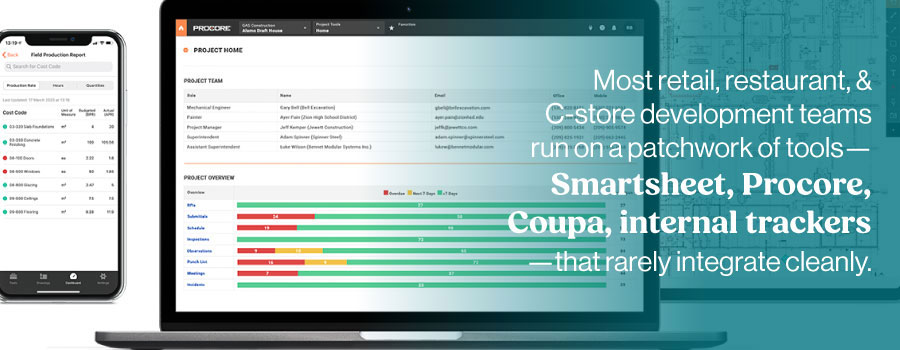
Most retail, restaurant, and C-store development teams run on a patchwork of tools—Smartsheet, Procore, Coupa, internal trackers—that rarely integrate cleanly. The result is data silos, manual reconciliation, and limited real-time visibility across the portfolio. A recurring issue: when GCs own the Procore account, documentation disappears after project closeout.
Part of this problem is structural. When design, construction, and program management operate as separate engagements with separate data—handed off sequentially rather than running in parallel—integration becomes an afterthought. Teams doing this well have moved toward a defined system of record, built owner-controlled platforms, and started rethinking how their delivery model is structured from the start.
Building a Multi-Unit Construction Program That Holds Up
The challenges facing retail, restaurant, and convenience store construction today are real—but manageable with the right program architecture and partners. The brands gaining the most ground aren’t just executing better within the traditional model—they’re rethinking how design, construction, and program delivery connect from the start.
WD works with brands across all three sectors to build development programs structured for real-world pressure: streamlined prototypes, strong GC pools, market-specific permitting strategies, and integrated delivery approaches that keep programs on track from concept through opening.
Frequently Asked Questions
How much do permitting delays typically add to a construction project?
What are the biggest cost drivers in retail, restaurant & C-store construction right now?
What makes a general contractor high-performing in multi-unit construction?
How can brands reduce permitting delays?
WD works with retail, restaurant, and convenience store brands to design, develop, and deliver built environments that perform. If your construction program is feeling the strain of today’s environment, we’d welcome the conversation.
Relevant Content
-
![Point of View - What Do Consumers Actually Want from the Drive-Thru of the Future?]() Point of View
Point of ViewWhat Do Consumers Actually Want from the Drive-Thru of the Future?
It’s Much Simpler Than You Might Think
-
![Point of View - A Digital Deep Dive]() Point of View
Point of ViewA Digital Deep Dive
All Things Digital and What it Means for Stores
-
![Solution Story - The Home Depot]() Solution Story
Solution StoryThe Home Depot
Delivering Scalable Growth for Doers Everywhere
-
![Point of View - Human-Centered Connected Commerce – From Store to Site]() Point of View
Point of ViewHuman-Centered Connected Commerce – From Store to Site
Innovative collaboration and human-centered design are essential for driving retail success