Design-Build Moved Retail Forward. Connected Delivery Moves the Program Forward.
WD’s Model for Turning Integrated Project Delivery Into a Program-Wide Advantage for Multi-Site Rollouts
Estimated Read Time: 10 Minutes

At a Glance
Design-build improved single-project delivery, averaging 3.8% less cost growth, 1.7% less schedule growth, and 102% faster delivery than design-bid-build (DBIA/CII-Pankow, 212 projects). But for retail brands opening dozens or even hundreds of locations, the same permitting, vendor, and prototype issues keep repeating store to store. Connected Delivery is WD’s model for extending the collaborative principles of Integrated Project Delivery (IPD) across an entire rollout (not just one project) so that what one store teaches the team improves every store that follows. A peer-reviewed 35-project study found IPD produced statistically significant gains across 14 performance metrics, including design-related changes dropping from 10% to 1.8% and change-order processing improving from a 4-week to a 1-week median.
Table of Contents
Anyone who has led a retail rollout knows the job is bigger than opening stores quickly.
Speed matters. But so does protecting the budget, managing permitting risk, keeping vendors aligned, maintaining brand standards, and making sure the same issue does not repeat itself across the next 50 locations.
That is where the real pressure lives.
Retail construction is too expensive and too visible for teams to learn the same lesson over and over again. Cushman & Wakefield’s 2026 U.S. Retail Fit Out Cost Guide places national in-line retail fit-out costs at roughly $157 per square foot (psf), up a modest 1.4% year-over-year (YOY) as softer demand offset ongoing labor and material pressures. Costs vary materially by market. Northern California ($217 psf), the Pacific Northwest ($202 psf), and New York City ($181 psf) are the most expensive markets, while the Midwest ($120 psf) and Southeast ($126 psf) remain the most cost-effective. Restaurants can run materially higher; industry sources often cite total opening and build-out costs with a median near $450 per square foot, depending on concept, scope, location, and project requirements.
Many retail leaders are feeling the pain with construction cost volatility and permitting delays among the top concerns for brands expanding their footprints.
That matters because the biggest risks in a rollout rarely show up as one big failure. They show up as repeatable friction:
- A permit assumption that was missed in one market and shows up again in the next.
- A prototype detail that looks good on paper but adds cost in the field.
- A vendor decision that comes too late to protect the schedule.
- An RFI that appears repeatedly because the lesson never made it back into the drawings.
- A budget variance that gets reported but not corrected at the program level.
On one project, those issues may feel manageable.
Across a national rollout, they become a program problem.
What Is Connected Delivery?
A one-sentence definition, and how it differs from Integrated Project Delivery (IPD)
Connected Delivery is WD’s model for applying the collaborative, single-system principles of Integrated Project Delivery (IPD)—the AIA’s model for uniting people, systems, business structures, and practices to improve outcomes on a single project—across an entire multi-site retail rollout, instead of one project at a time. It connects business goals, prototype strategy, design and engineering, cost intelligence, permitting, procurement, vendor performance, construction execution, reporting, turnover, and continuous improvement into one accountable system across every store in the program.
The real difference in one line: IPD integrates the team on a single project. Connected Delivery integrates an entire portfolio of projects, so what one store teaches the team carries forward and improves the next one.
Design-Build Solved a Real Problem
Does design-build solve program-level problems, or just project-level ones?
Design-build was a major step forward for the industry. By bringing design and construction under one contract, design-build reduced some of the friction created by more traditional delivery models. The Design-Build Institute of America describes the single contract between owner and design-builder as the fundamental distinction between design-build and other delivery systems.

And the performance data supports the model. A CII/Pankow study of 212 projects found that design-build projects were delivered faster and with lower cost and schedule growth than construction manager at risk and design-bid-build projects. DBIA’s summary of that research reported the following results:
Design-Build vs. Design-Bid-Build Performance
| Metric | Design-Build Result |
|---|---|
| Cost growth | 3.8% less than design-bid-build |
| Schedule growth | 1.7% less than design-bid-build |
| Delivery speed (design through completion) | 102% faster than design-bid-build |
That is meaningful.
Design-build improved coordination. It accelerated decision-making. It helped owners move away from the limitations of sequential handoffs. So this is not an argument against design-build. Design-build works.
But for brands delivering dozens or even hundreds of stores, remodels, refreshes, or pilots, the question has changed. The challenge is no longer just: Can we deliver this project well?
The better question is: Can we make the entire program perform better with every project we deliver?
That is where design-build often reaches its limit.
Retail Rollouts Need a Program Operating System
Why does a single store’s delivery model break down across a national rollout?
A single store has a budget, schedule, permit path, construction plan, vendor strategy, landlord condition, and opening date. A national rollout multiplies that complexity across different jurisdictions, trade bases, utility conditions, landlords, vendors, prototype versions, and market realities. The risk is not simply that one store slips. The bigger risk is that the same issue keeps showing up because the delivery model is not designed to capture, share, and act on what the team is learning.
A McKinsey study identified fragmentation as one of the construction industry’s biggest structural challenges, contributing to decades of lagging productivity. Disconnected handoffs, siloed teams, and limited shared data continue to create waste, rework, and lost value.
For retail leaders, that is not theoretical. That is the day-to-day reality of managing a rollout when strategy, design, estimating, permitting, procurement, construction, and reporting are operating as separate workstreams instead of one connected system.
This is where Connected Delivery becomes powerful.
Connected Delivery Connects the Full Rollout
What does Connected Delivery actually connect?
Building on Integrated Project Delivery principles, Connected Delivery applies the same integration logic across an entire multi-site rollout, not just one project.
It connects:
- Business goals
- Prototype strategy
- Design and engineering
- Cost intelligence
- Permitting strategy
- Procurement
- Vendor performance
- Construction execution
- Reporting
- Turnover
- Continuous improvement
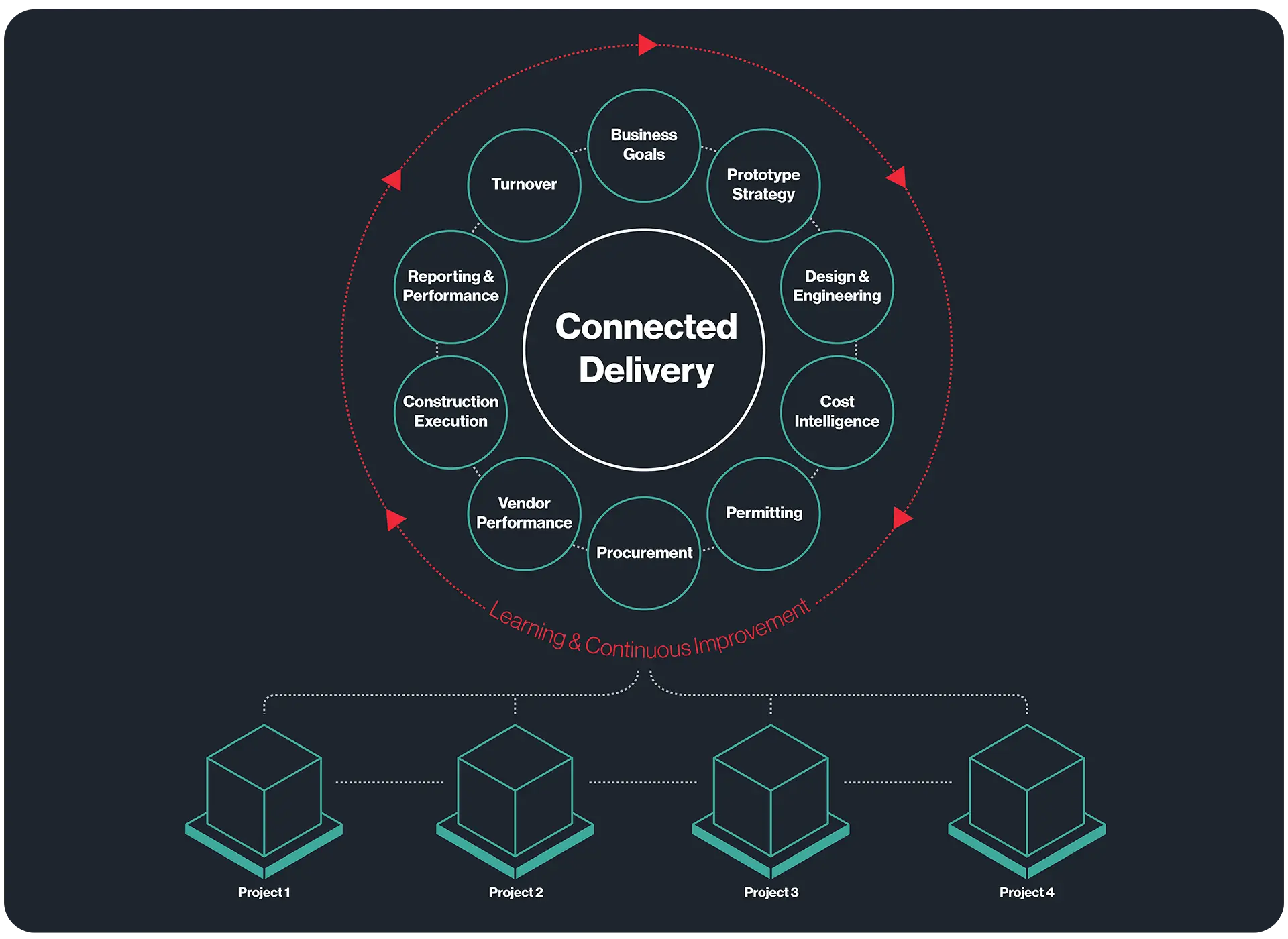
In practical terms, it means designers, engineers, permit leads, cost managers, construction leaders, vendors, and owner stakeholders are solving the same problems together…earlier, faster, and with better information.
Instead of passing issues from one silo to the next, the team works as one operating system.
That is the shift.
Design-build strengthens the relationship between design and construction.
Connected Delivery expands the model to include the full set of decisions and feedback loops that determine whether a rollout actually improves over time.
Integration Reduces Waste Before It Reaches the Field
How does early integration reduce rework and cost?
The Lean Construction Institute has long identified traditional handoffs as a source of waste, delay, and rework. Its Lean Project Delivery System, pull planning methods, and Last Planner System all point to the same principle: teams perform better when they plan collaboratively, work backward from the desired outcome, and address constraints before they become field problems.
For a retail rollout, that discipline compounds.
If one store teaches the team something about permitting, procurement, prototype documentation, cost escalation, or vendor performance, the next store should benefit from that knowledge.
The Construction Industry Institute’s research on Front End Planning makes the business case even stronger. CII has found that money invested in early planning can generate significant downstream savings, often cited in the industry as $10–$20 saved in construction for every dollar invested early.
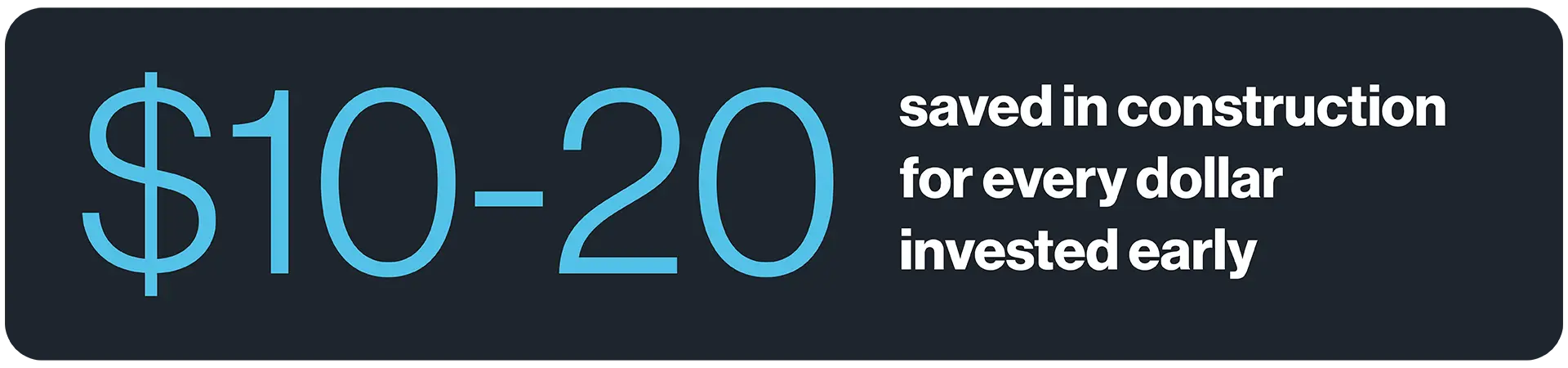
For retail leaders, that reframes the value of planning. The time spent aligning strategy, prototype decisions, market requirements, procurement, and execution is not overhead. It is one of the highest-return investments in the program.
The Evidence Favors Integrated Delivery
What data supports Integrated Project Delivery’s performance?
The case for integration is not just intuitive. It is supported by performance data.
A peer-reviewed study by El Asmar, Hanna, and Loh compared IPD with more established delivery models, including design-bid-build, design-build, and construction manager at risk. Using quantitative data from 35 completed projects, the study found statistically significant improvement for IPD across 14 metrics in six performance areas, including:
- Quality
- Schedule
- Project changes
- Stakeholder communication
- Environmental performance
- Financial performance
The authors concluded that IPD delivered higher-quality facilities faster, without a significant cost premium.
While that study was not retail-specific, the findings are highly relevant to retail programs because the improved metrics map directly to the issues that create friction in multi-site delivery: deficiencies, punch lists, RFIs, design changes, regulatory changes, and change-order processing.
The reported improvements are compelling:
IPD vs. Non-IPD Performance
| Metric | Non-IPD | IPD |
|---|---|---|
| Design-related changes | 10% | 1.8% |
| Regulatory-agency changes | 5% | 0% |
| Change-order processing (median) | 4 weeks | 1 week |
| RFI processing (median) | 2 weeks | 1 week |
For a retail leader, those numbers translate into something very practical:
- Fewer surprises
- Cleaner documentation
- Faster decisions
- Fewer repeat issues
- Better cost control
- Stronger schedule reliability
- More confidence moving from one store to the next
That is exactly what large-scale retail programs need.
The Hidden Cost Is Fragmentation
What is the biggest hidden cost in multi-site retail construction?
In many retail programs, the biggest cost is not always visible in the estimate. It is fragmentation.
Every handoff between strategy, design, estimating, permitting, procurement, construction, turnover, and reporting creates another opportunity for intent to shift, information to get lost, or risk to surface too late.
That fragmentation creates real cost: RFIs that should have been prevented, change orders that could have been anticipated, permit delays that were predictable, vendor issues that were known but not shared, prototype decisions that added cost without adding value, and lessons learned that never made it into the next drawing set.
FMI’s research on owner perspectives in project delivery reinforces why this matters. Owners consistently place high value on execution consistency, contractor reliability, and predictable performance. For multi-site programs, the lowest initial price rarely tells the full story. Apparent savings can quickly disappear through change orders, schedule compression, rework, and management time spent correcting avoidable issues.
The better-performing brands treat their delivery network as a managed program asset, not a recurring procurement event. That is the mindset shift Connected Delivery supports.
From Managing Projects to Improving Programs
What’s the practical difference between managing a project and operating a program?
The value of an integrated model is not simply that multiple services sit under one roof. The value is that the learning stays inside one system.
When recurring RFIs appear, the next drawing set improves. When permitting patterns emerge, market sequencing adjusts. When prototype decisions consistently add cost or delay, the team responds earlier. When vendor performance varies by region, sourcing and buyout strategies adapt. When schedule variance appears, the team addresses the root cause instead of simply reporting the miss.
That is the difference between managing projects and operating a delivery program.
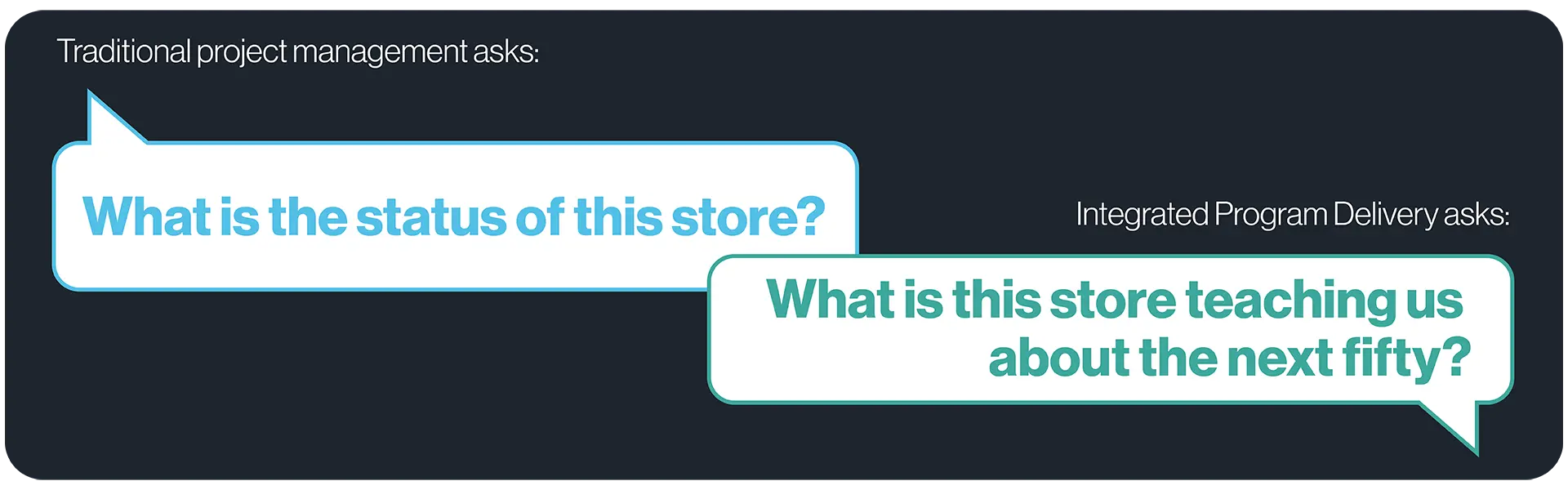
For national brands, that second question is where the value lives.
Every store, remodel, refresh, and pilot should make the system smarter. Every cost variance should sharpen the next estimate. Every permit delay should refine the next jurisdiction strategy. Every field issue should improve the next prototype release. Every vendor challenge should strengthen the next buyout.
That is how programs get better.
Why This Matters Now
Why is this the right moment for retail brands to adopt Connected Delivery?
Retail brands are operating in a more complex environment than ever.
Construction costs remain high. Permitting remains unpredictable. Labor and vendor capacity vary by market. Capital plans are under more scrutiny. At the same time, brands are expected to move quickly, protect experience standards, and make smarter investment decisions across the portfolio.
That environment rewards delivery models that are connected, transparent, and built to learn.
Design-build helped the industry move beyond the limitations of traditional project delivery. Connected Delivery is the next evolution for brands that need more than project execution. They need program performance.
The future of retail delivery is not more meetings, more disconnected reporting, or more isolated specialists. It is a connected operating model that links design intent, cost, schedule, permitting, procurement, construction, turnover, and learning into one accountable system.
The Next Step for Retail Programs
Design-build was a major step forward. Connected Delivery is the next one.
For brands growing at scale, the question is no longer simply whether a partner can deliver a project. The better question is whether that partner can help every project improve the program.
At WD, a national retail construction and program delivery firm, we help brands connect strategy, design, engineering, construction, and program management into a more accountable delivery model, one designed not only to open stores, but to improve performance across the portfolio.
If your brand is rethinking how it plans, delivers, and learns across a multi-site rollout, we’d love to have a conversation. Reach out to Mike Morton, Senior Vice President at WD Partners – mike.morton@wdpartners.com.
Frequently Asked Questions
What is Connected Delivery?
How is Connected Delivery different from design-build?
What data supports Integrated Project Delivery’s performance?
How much does design-build improve project performance versus design-bid-build?
What is the biggest hidden cost in multi-site retail construction?
Why does early planning matter so much in retail construction programs?
Relevant Content
-
![Point of View - Winning in Today’s Retail Ecosystem]() Point of View
Point of ViewWinning in Today’s Retail Ecosystem
Why Other Retailers Should Take the DICK'S Sporting Goods Approach
-
![Solution Story - Nike]() Solution Story
Solution StoryNike
Standardizing Store Operations Manuals to Drive Consistency & Growth
-
![Wayfind - The Sweet State of Snacking]() Wayfind
WayfindThe Sweet State of Snacking
Highlights from the Sweets & Snacks Expo
-
![Point of View - Women in Sport]() Point of View
Point of ViewWomen in Sport
Don't Leave Her on the Retail Sidelines